roaster : air vs drum
( from instagram post 2025.6.5 )
I have wanted to write more about roasting, yet putting roasting concepts into simple words is no easy task. Moreover, most machines do not work in the same way. Last year I switched from Diedrich IR-1 to ROEST L100 plus, and found profound differences in the approach to heat control. Some even challenged my core beliefs such as "Must charge at high bt", "Always start with low airflow" etc.
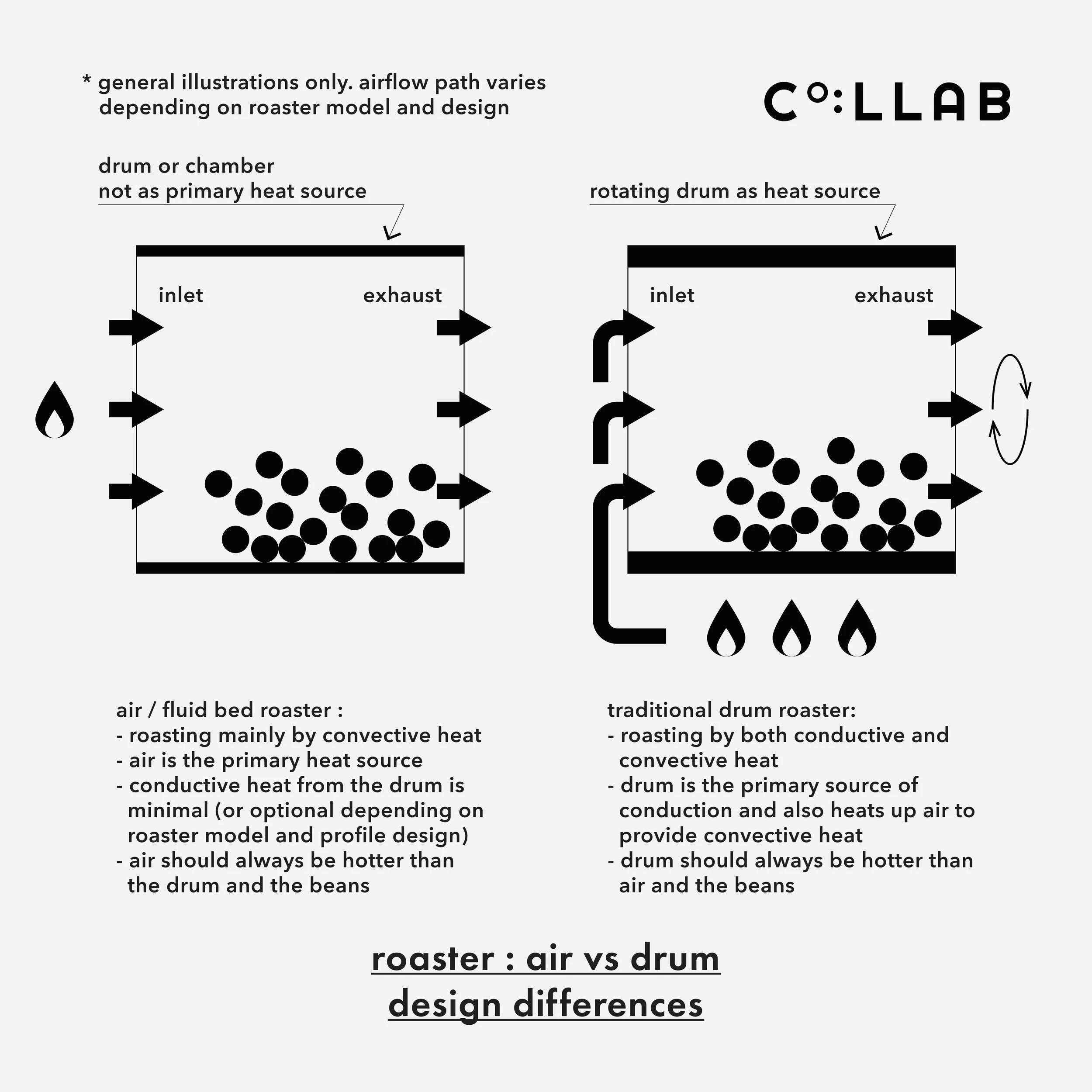
The fundamental difference between L100 plus and IR-1 is the source of heat energy. L100 plus is an air roaster, meaning convective heat is the primary energy source (although it is possible to profile and make it more conductive). Therefore, inlet air is always hotter than the beans and the drum.
On the contrary, IR-1 is a traditional drum roaster with the drum being the primary source of energy. Please note that it does not equal "conductive heat being the primary source of energy" which is untrue. Convective heat still plays a major role while the drum acts as an energy source that heats up the air before it enters the chamber. In this regard, the drum should always be hotter than the air and the beans.
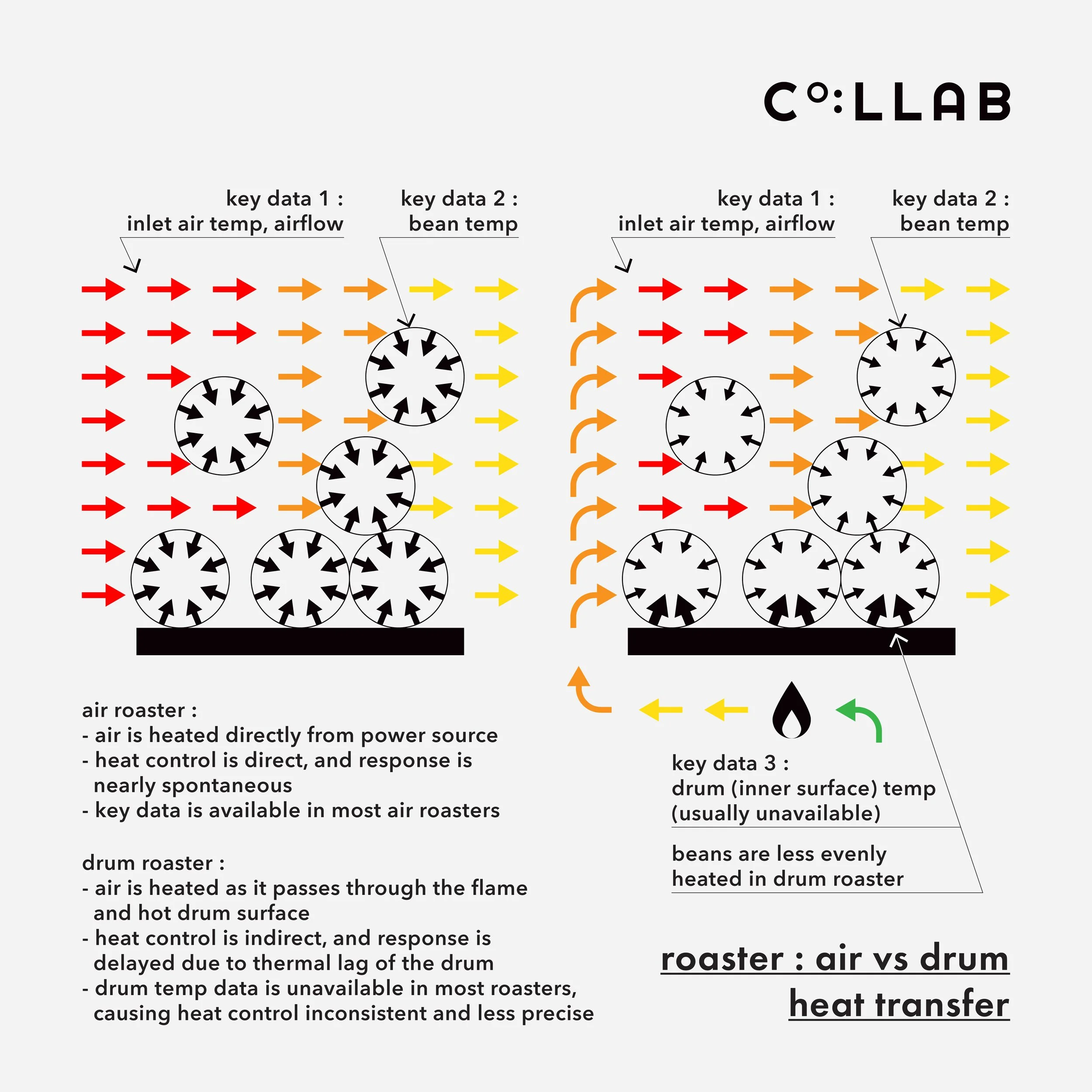
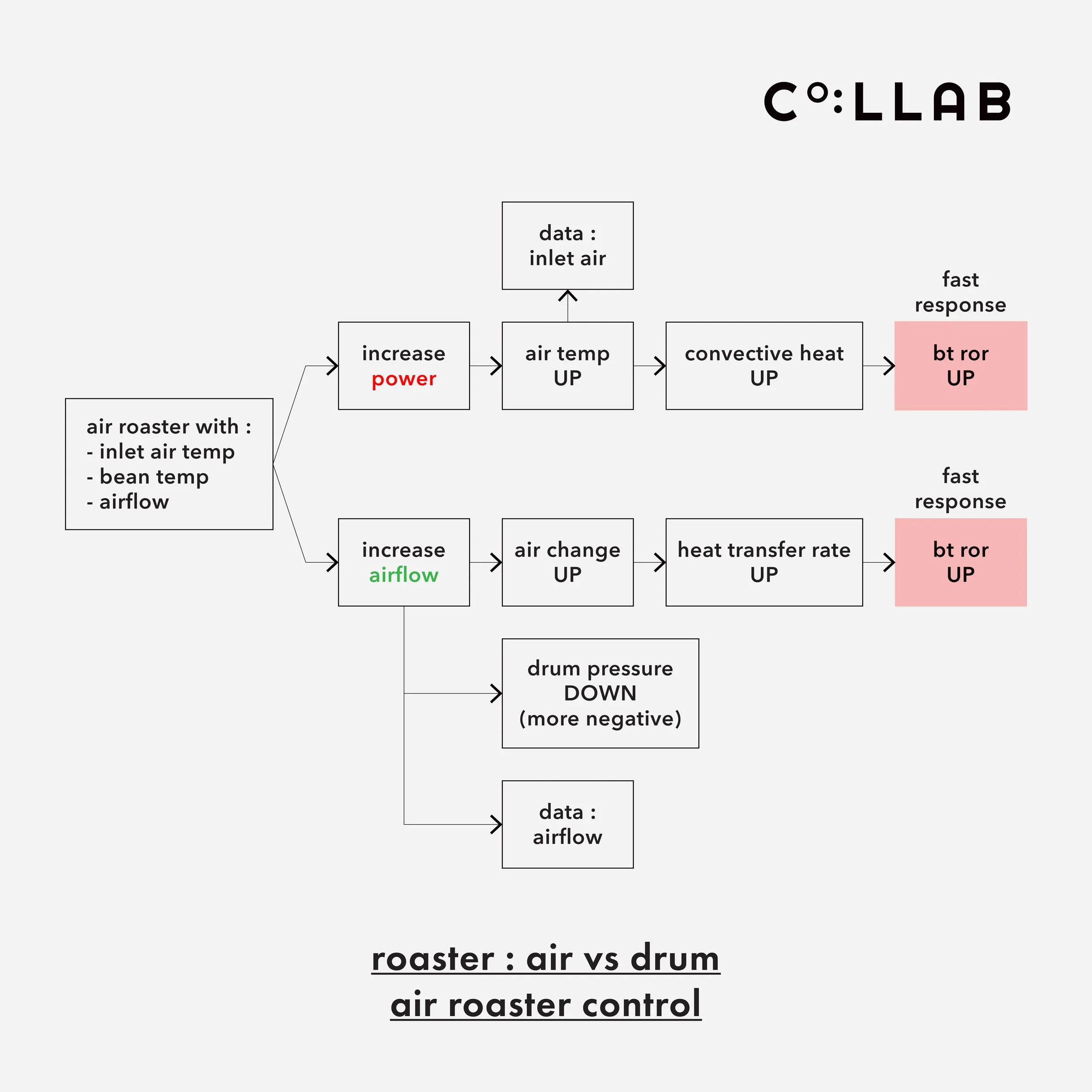
Thanks to the simpler heat transfer mechanism in air roaster, one can easily monitor roast progress by checking the inlet air temp and bean temp (bt + bt ror). Heat control is also straightforward: you increase the power or airflow, you speed up the roast. Response is almost instant, and that makes me feel less panicky when making adjustments on-the-fly.
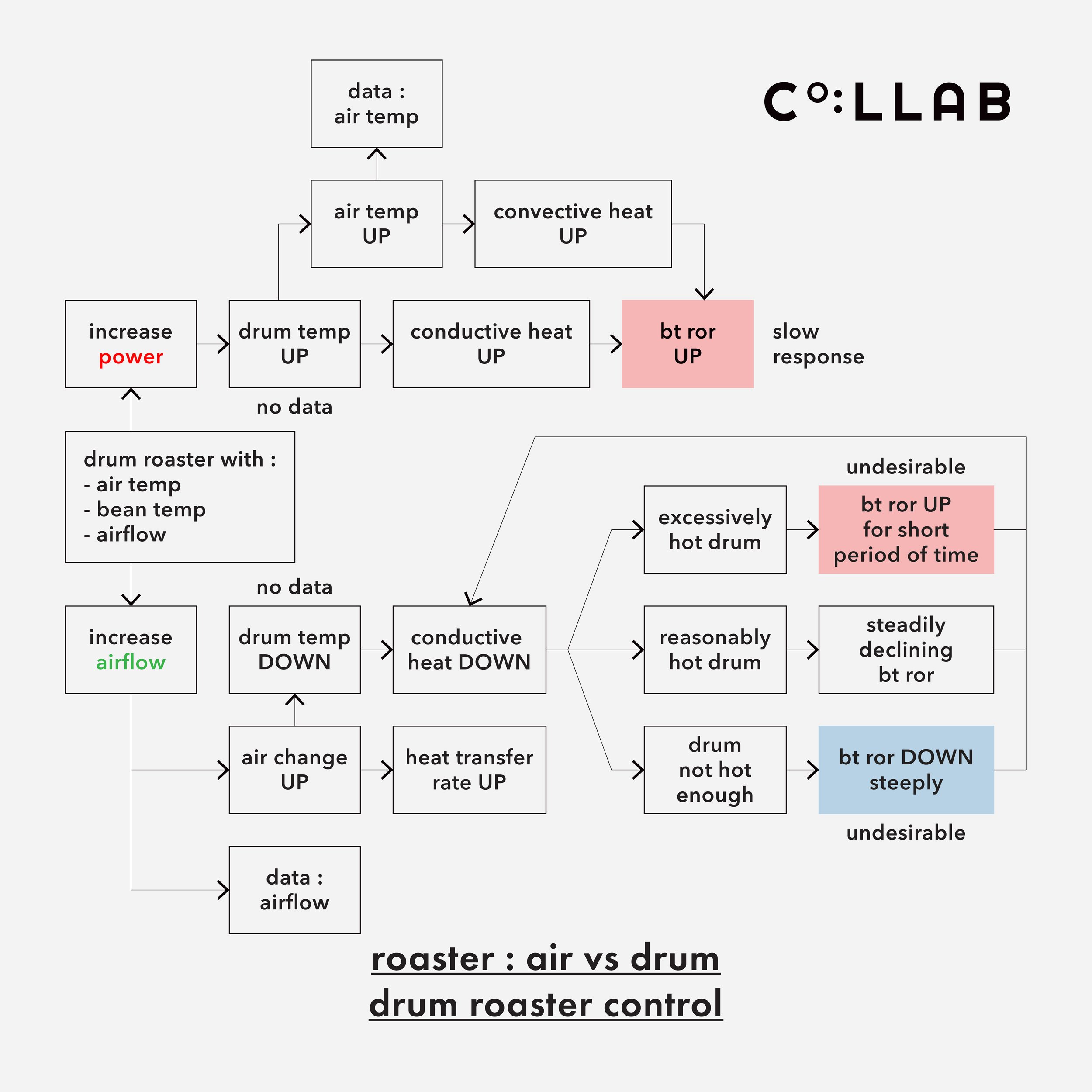
Controlling heat in drum roaster is instead trickier. As both conduction and convection are involved, in theory, we should monitor the amount of drum heat (i.e. inner drum surface temp) in addition to air temp and bt, but such data (drum temp probe) is unlikely available.
Besides, the drum's thermal lag can make heat control somewhat sluggish. As the drum needs to absorb or release heat before it has an effect on the air temp then the bt, it can take up to 20 seconds from adjusting power to seeing a change in the bt ror curve.
Another challenge in drum roaster is the impact of airflow change. Higher airflow results in more air drawing heat from the drum. At the expense of conductive heat, convective energy will increase for a period of time, then drop again as the drum cools down. Therefore, we were all taught to adjust airflow always at the same bt or time to maintain a steadily declining bt ror, and strictly follow warmup and between-batch protocols to ensure the drum's thermal mass is reset consistently.
I love both IR-1 and L100 plus. They are superbly built machines and very fun to use, just in a different way. Do you have other roasting tips or experience? Let's share in the comments and learn together.