heat in roasting
( from instagram post 2025.6.13 )
(Note: The following is purely based on roasting experience and personal learning. Some of it can be wrong, or may not fully apply to your roasting system. Feel free to comment / dm if your experience differs - I believe in sharing and inspiring thoughts)
Heat in roasting is about 3 things:
Knowing how the beans react to heat at different stages
Relating heat reactions to roast profiles and cupping notes
Controlling heat to achieve target curves and parameters
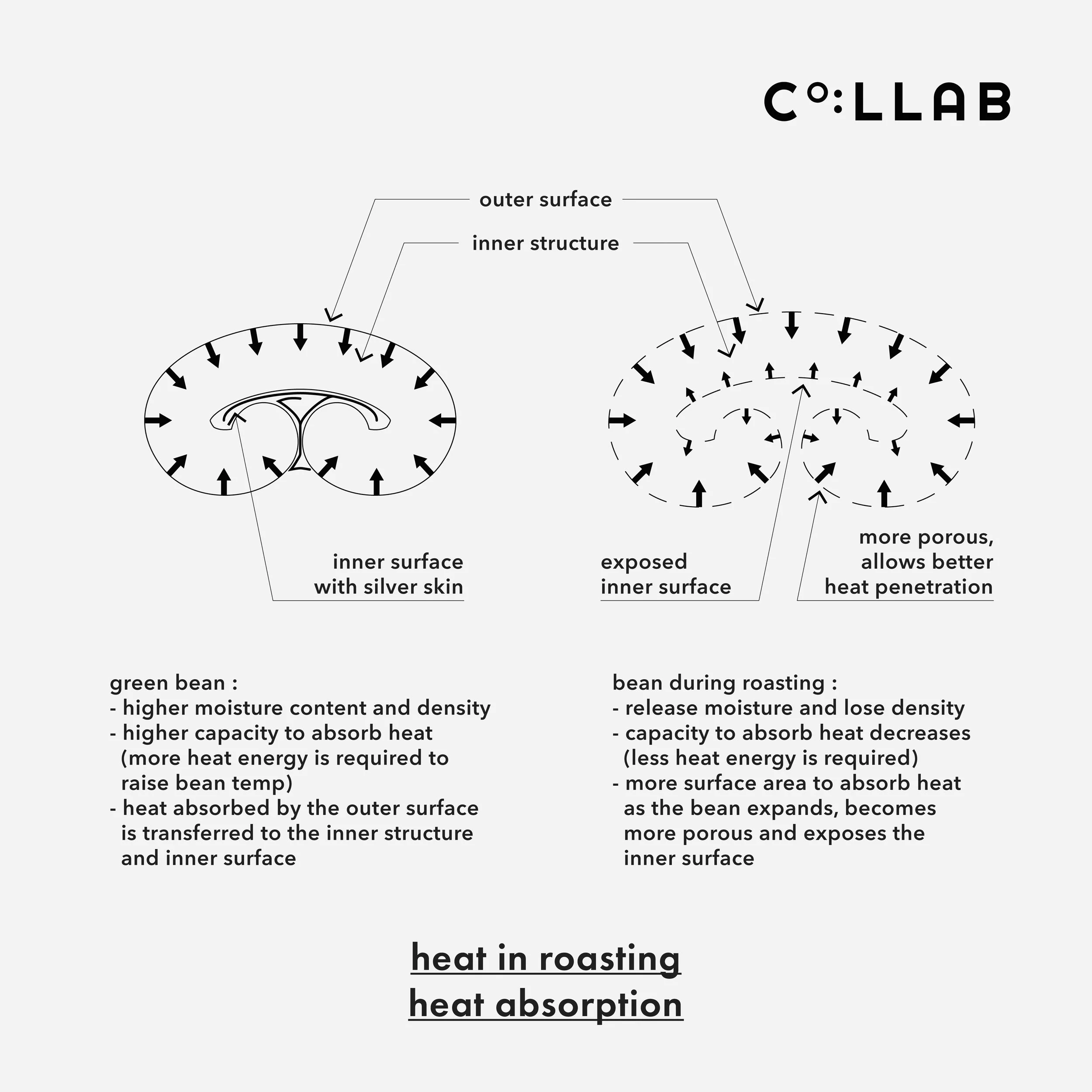
While everyone's roasting style may vary, we were all taught to charge a batch with high power then gradually reduce towards the first crack (fc). It is because green beans are dense, they are more capable of absorbing heat and transferring to the inner structure. Imagine heating a saucepan full of water: it requires more energy to raise the same temperature than an empty one. As the beans are heated, they expand, become porous and gradually lose moisture, density as well as the heat-absorbing capacity.
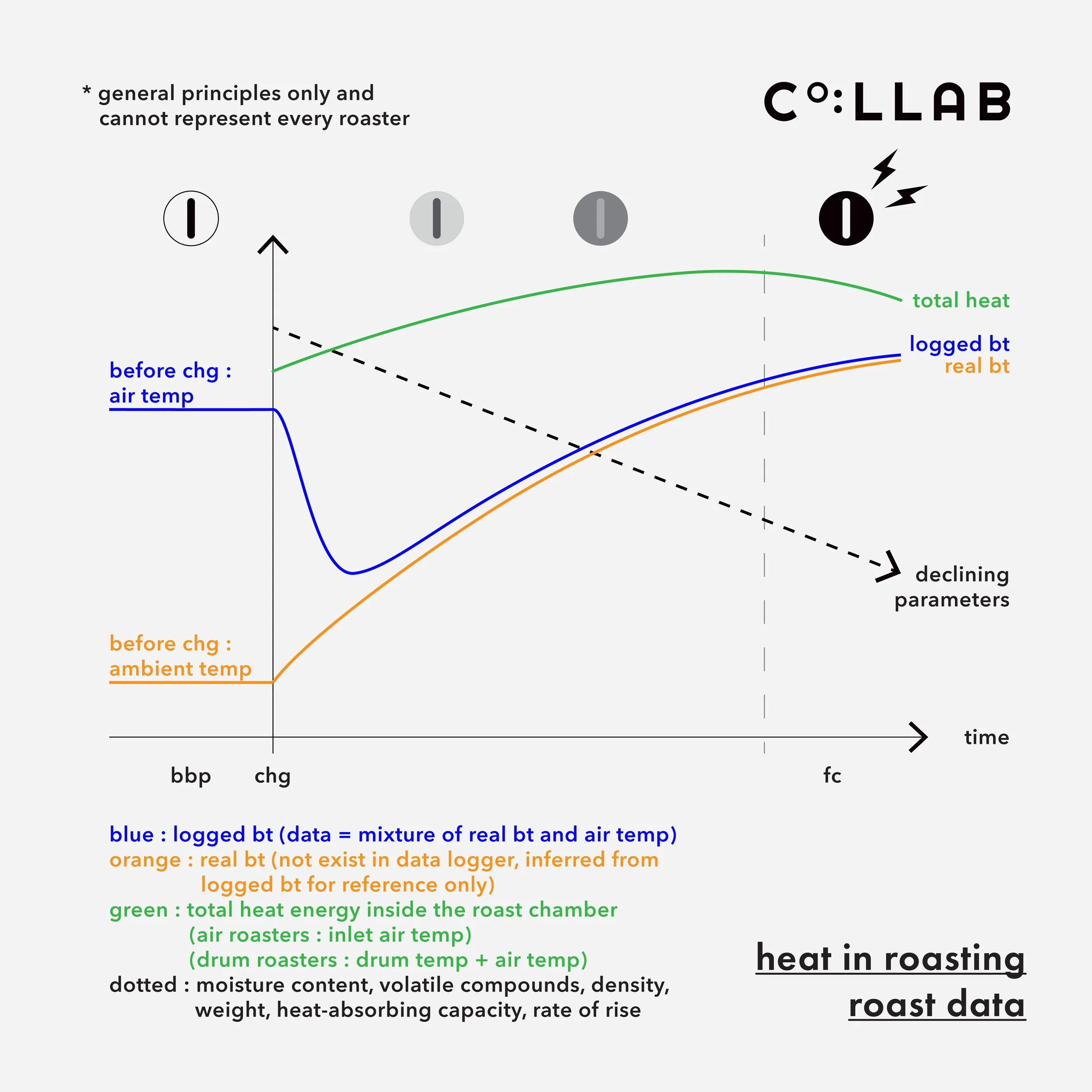
Bean temp (bt) is the most important data to roasters. It is detected and logged by thermocouple such that we can decide when to adjust power and by how much. However, it is worth to note some deviations between the "logged bt" and the actual temperature "real bt":
The thermocouple is always in contact with bean surfaces and hot air, thus the "logged bt" actually represents a mixture of "real bt" and air temp
Accuracy of the "logged bt" greatly depends on the response time and placement of thermocouple. The values can be higher or lower than the "real bt"
Before a batch is charged, "logged bt" is actually the air temp. Therefore, its data before the turning point has little relevance to the actual roasting condition
Bt is directly influenced by the amount of heat inside the chamber, and this "total heat" comprises heat from conduction and convection (radiation omitted for simplicity). For air roasters, the "inlet air temp" curve is good enough to represent "total heat". For drum roasters that is equipped with drum temp readings, it is also possible to create a calculated "drum + air temp" curve to track the "total heat".
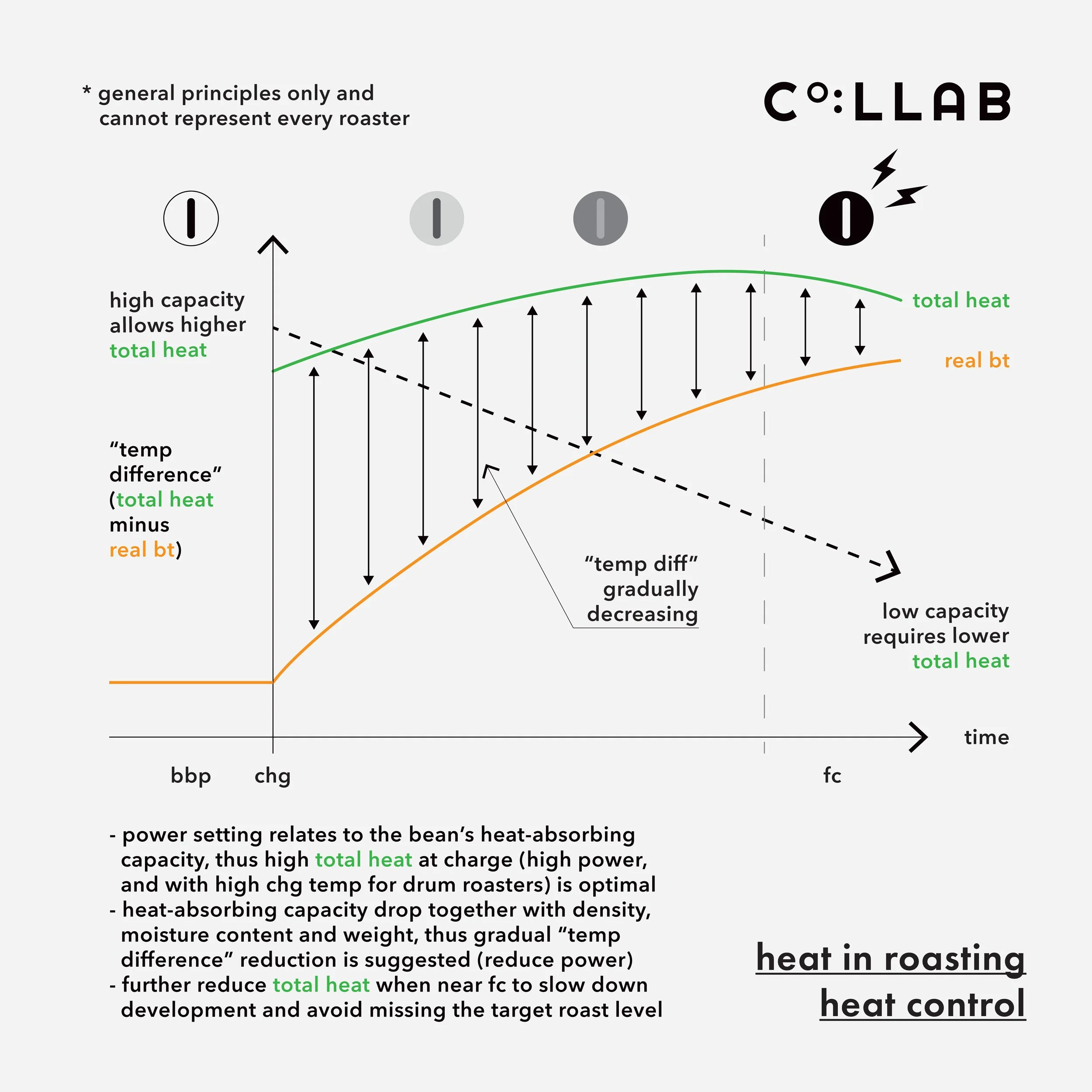
In spite of my own opinion, I found the "temp difference" ("total heat" minus bt) a very useful indicator to design my power settings (last image). As mentioned that heat-absorbing capacity gradually drops, I believe the "temp difference" should also decrease such that the beans are not getting burnt by excessive heat.
As the roast approaches near fc, I will further reduce the "temp difference" to slow down development such that I can hit the target roast level safely.