green bean
( from instagram post 2025.7.11 )
Studying new coffees before charging the first batch is a common practice to most roasters. It is because every lot is unique - its origin, variety, grown altitude, processing method, crop year, moisture content, density, bean size, etc - all of these have impact on how the beans react to heat.
Some notable factors:
1. Moisture content
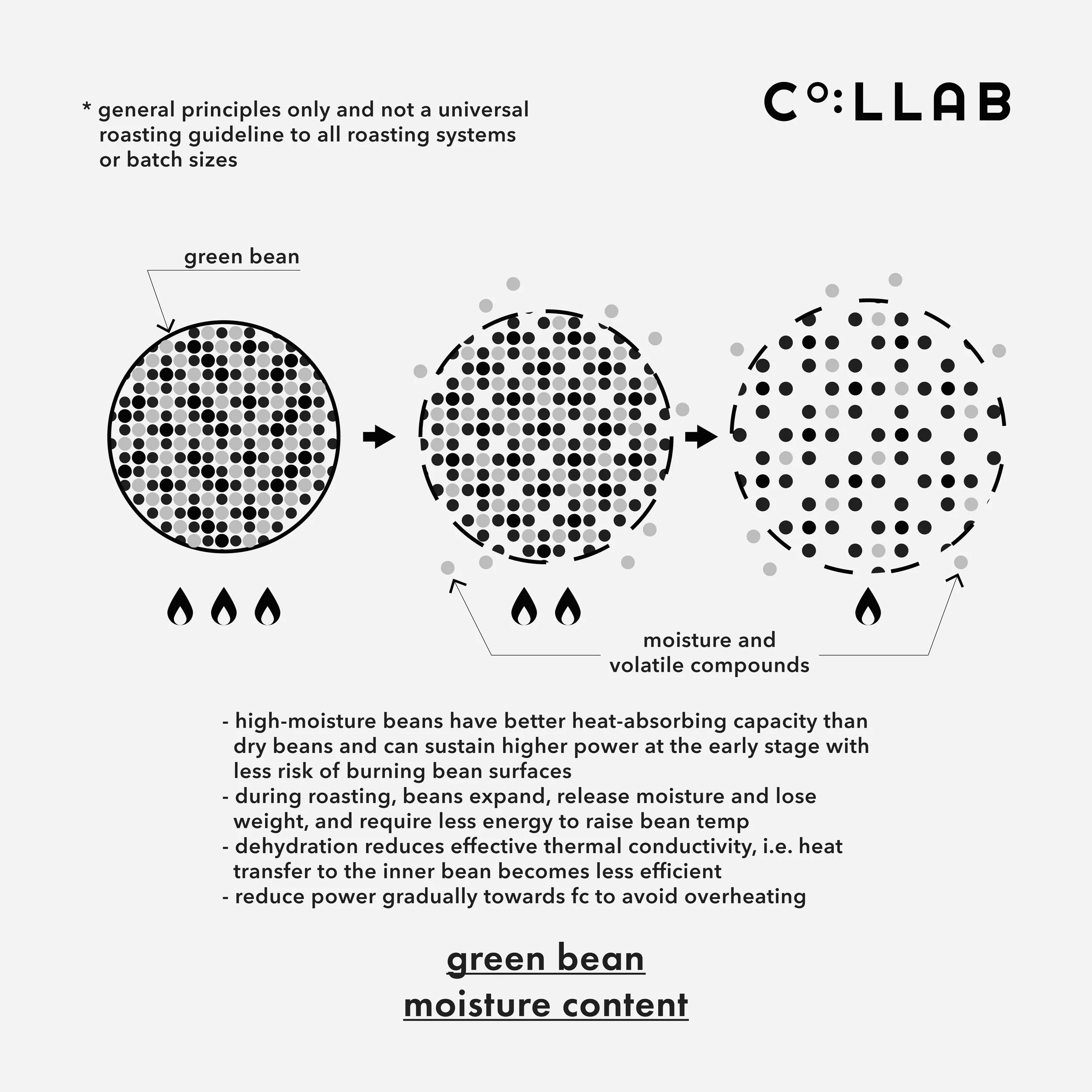
According to the SCA Green Coffee Classification, moisture content of green coffee is 9-13% and can be measured by a moisture meter. A general understanding is that high-moisture beans can absorb heat more efficiently than dry beans, and can sustain relatively higher power at the early stage with less risk of burning bean surfaces. It is due to the relationship between moisture and thermal conductivity (i.e. efficiency of heat transfer to the inner bean).
During roasting, beans expand, release moisture and lose weight such that they will require less energy to raise bean temp. At the same time, dehydration cause effective thermal conductivity to drop. As the heat transfer becomes less efficient, overheating of bean surfaces may occur and induce burnt flavors. Gradually reducing power from mid-roast towards fc is a possible way to avoid this situation.
2. Density and size
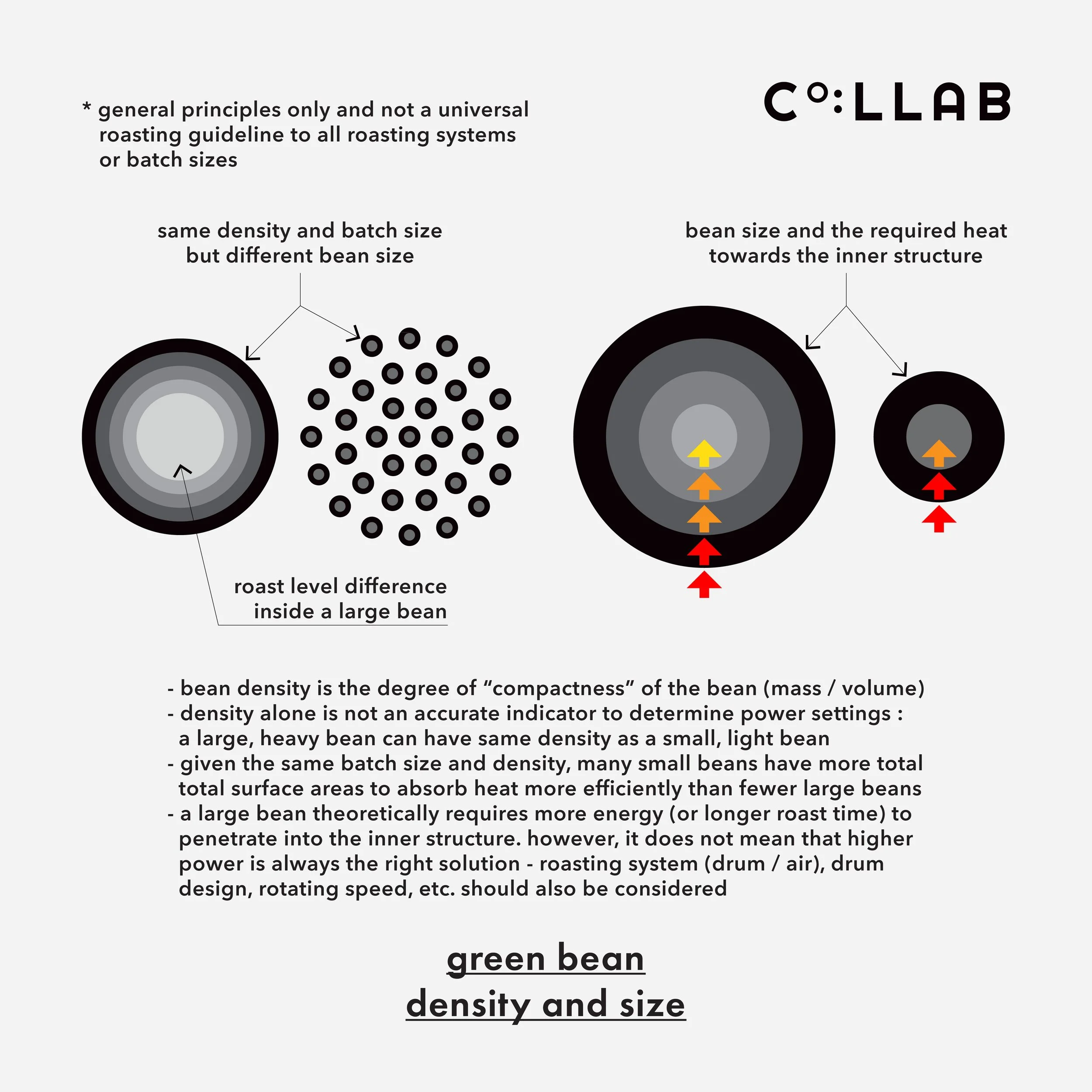
Density is a bit trickier. By definition, density is the degree of "compactness" of an object (i.e. mass / volume). Therefore, it is possible that a large heavy bean and a small light bean can have same density, and I have learnt to not use it as the only indicator to determine power settings.
Let's explain with a hypothetical example: A 10-kilo batch of spherical beans, and density is 1,000 kg/m³. It can either be a batch of 10,000 beans, each weighs 1 gram and is 1 cm³ big (approx. 1.2 cm diameter); or a single, XXL bean that weighs 10 kilos and its volume is 10,000 cm³ (approx. 26.7 cm diameter). Both have same density yet their reactions to heat (roast curves) are totally different.
Although not all beans are spherical in reality, a batch with many tiny beans has more total surface areas than one with fewer large beans, making heat absorption a lot more efficient. On the contrary, large bean is thicker and requires more energy (or longer roast time) for heat to penetrate into the core.
Besides, mass and volume also affect how the beans are lofted inside the drum, i.e. proportion of contact times with air (convection) and drum surface (conduction). In conjunction with other factors such as roasting system (drum / air), drum size, material, rotating speed, blade configuration, batch size, etc, it is virtually impossible to come up with a universal density guideline that can apply to all machines.
Having said that, I still use density as a supplementary info in my green coffee database which includes origin, variety, grown altitude, processing method and moisture content. Having developed over years of roasting, it helps me to identify patterns and predict roast profiles suitable for the current roastery setup. I am able to dial-in coffees in fewer test batches.