bean development
( from instagram post 2025.7.22 )
(Note: As already mentioned in earlier posts, the diagrams, charts and figures (percentage, temperature, time, weight, etc.) are only references that help to deliver my thoughts more effectively and are not meant to be prescriptive. By sharing ideas, I want to encourage interactions with other coffee lovers: whether they are inspired to explore roasting or brewing at different angles, or share their own experiences, or even correct my mistakes or inaccuracies. I'll feel most grateful when we all share and grow together.)
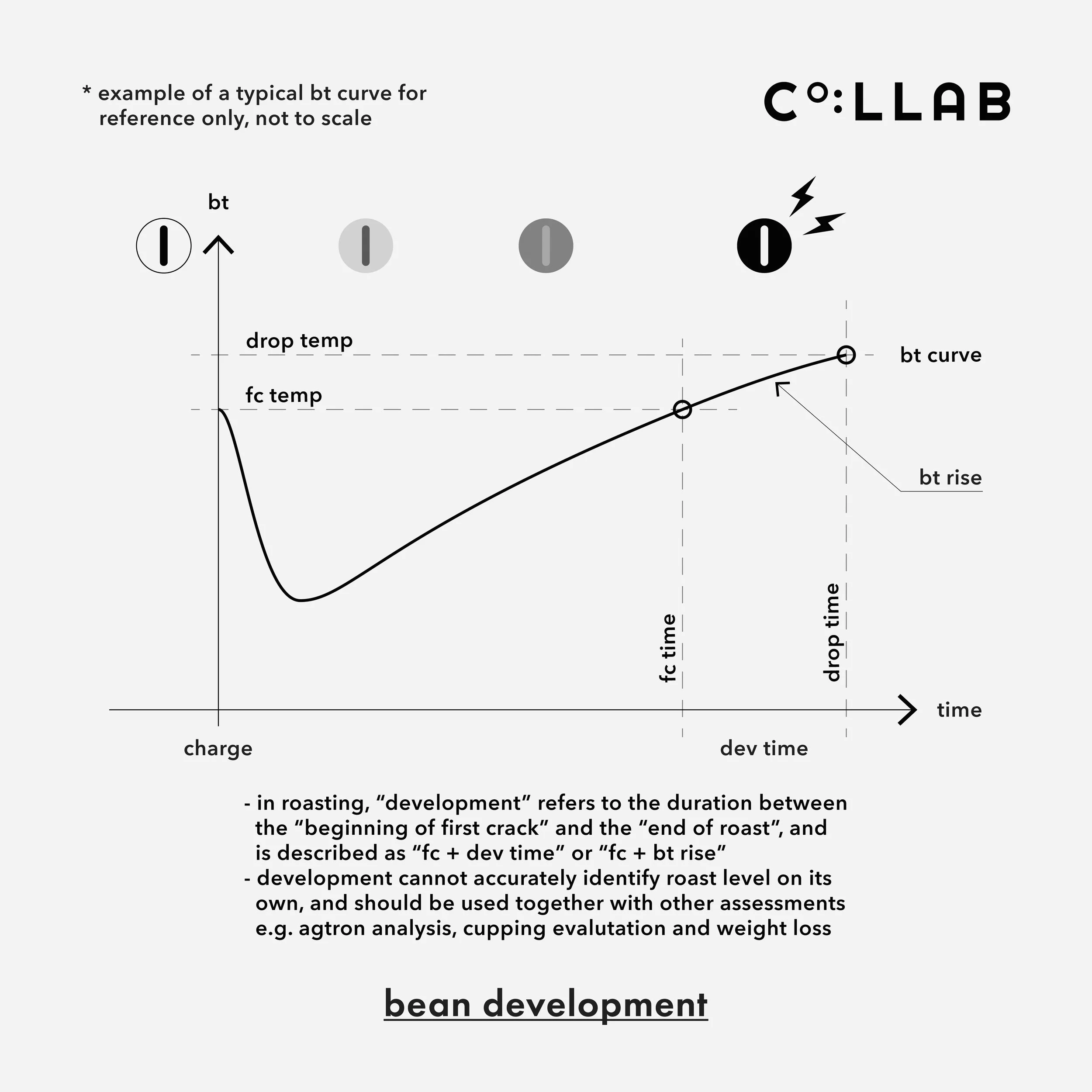
When a batch is charged, a series of physical and chemical reactions occurs - dehydration, maillard reaction, caramelization, etc. - all constitute the bean development.
When roasters mention "development", it instead specifies the duration between the beginning of first crack (fc start) and the end of roast (drop). It is the final phase of roasting and is described as "fc + dev time" or "fc + bt rise".
Development can assist roaster to identify roast level but should be used together with other assessments such as agtron analysis, cupping evaluation and weight loss. Simply describing it as "fc + 50s" without context can be misleading: it can be a mid-light roast for one coffee but an under-developed roast for another. The relationship between development and roast level is also dependent on the machine and roasting approach.
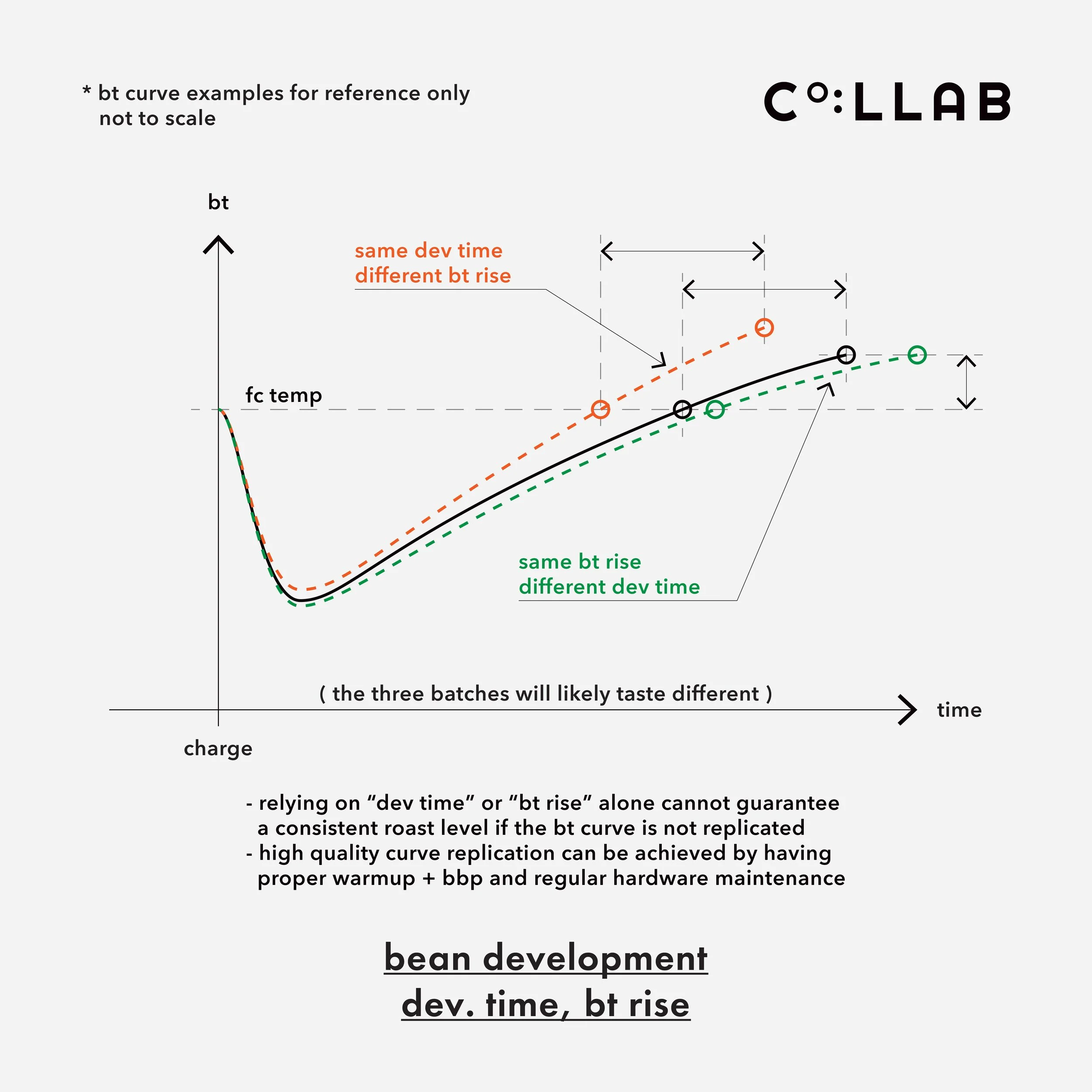
As a guiding tool, dev time or bt rise is most effective when the roast curve can replicate the control curve. A batch significantly faster or slower than the control curve will result in deviation of the "fc start" which compromises precision and consistency.
A deviated curve cannot be saved by simply adjusting dev time, bt rise or drop time/temp. Instead, one can improve the quality of replication by having proper warmup + bbp and regular hardware maintenance. Inconsistency can possibly be caused by dirty exhaust pipe or the hatch door of chaff bin not locked properly (air leakage).
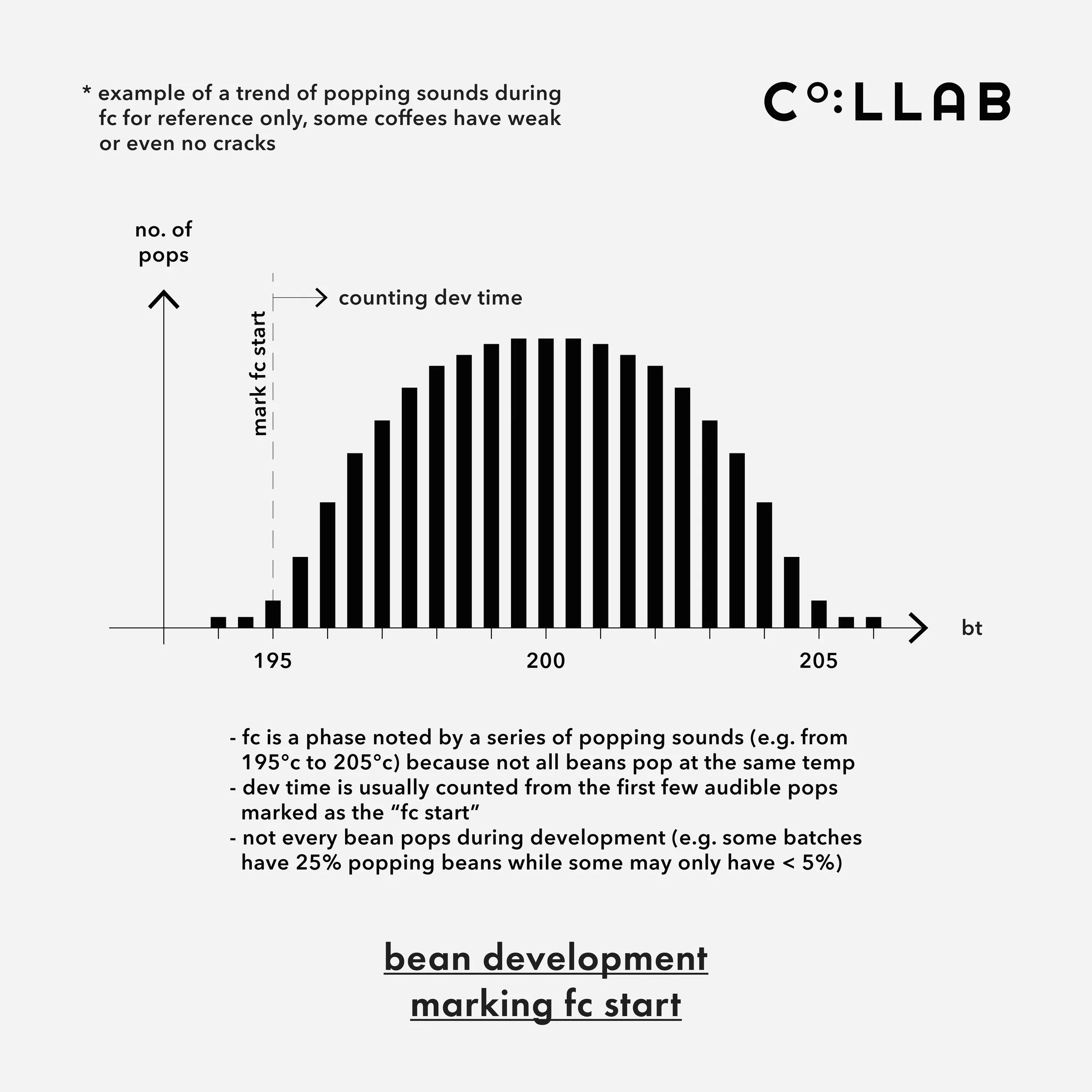
It is also worth to note that the crack (popping sound) has little connection with cup quality. Coffees can be well-developed with weak or even no cracks. For example, if fc of a batch of 10,000 beans begins at 195°c and ends at 205°c with 2,000 audible pops, it means there is only 20% chance that a randomly picked bean has cracked somewhere between 195°c and 205°c.
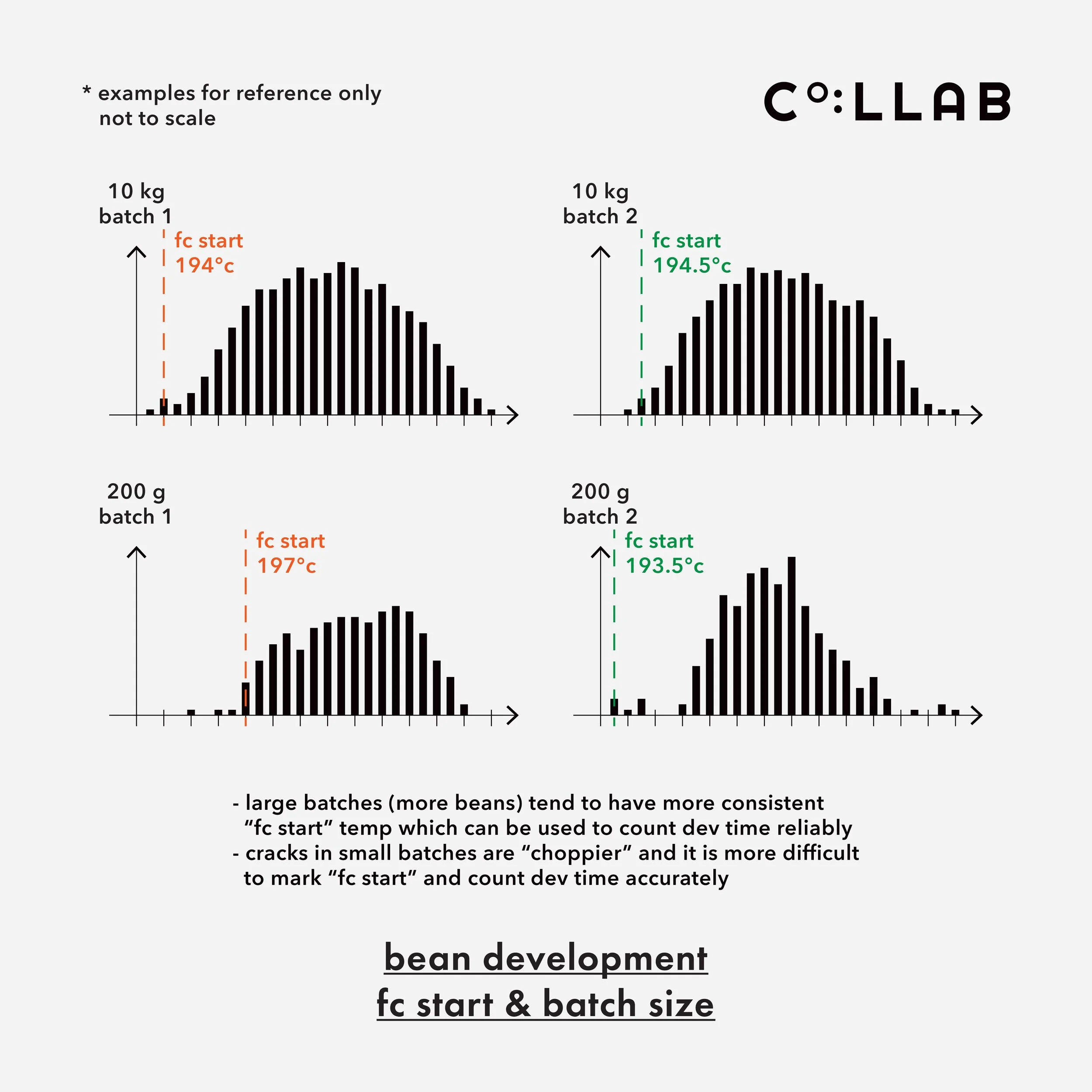
Large batches tend to have continuous, vigorous cracks which allow roasters to mark the same "fc start" every time reliably. Cracks in small batches are instead "choppier" and it is more difficult to mark "fc start" and count dev time accurately.